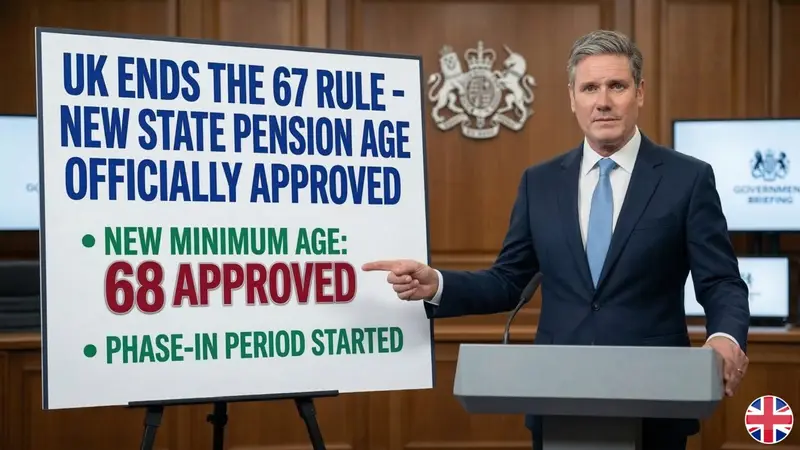
The United Kingdom’s pension system is once again at the center of national discussion after fresh developments surrounding the State Pension Age. For years, many people believed the retirement benchmark would remain firmly tied to age 67. However, recent policy confirmations and government reviews have sparked widespread debate about whether the long-standing “67 rule” is effectively coming to an end and what future retirees should realistically expect.
For millions of workers planning their retirement, the State Pension Age is more than just a number. It determines when individuals can finally step away from full-time work and begin receiving financial support from the government. Any change — even a small one — can reshape long-term financial plans, savings strategies, and lifestyle expectations. That is why the latest announcement has attracted attention across households, workplaces, and financial planning circles alike.
Understanding the State Pension Age System in the UK
The State Pension Age refers to the age at which individuals become eligible to claim the UK State Pension, provided they have made sufficient National Insurance contributions during their working lives. Historically, this age has gradually increased as life expectancy improved and economic pressures on public finances grew.
Decades ago, retirement at 60 or 65 was common. Over time, however, demographic shifts forced policymakers to rethink sustainability. With people living longer and drawing pensions for extended periods, governments introduced phased increases to maintain balance within the system. The move toward age 67 was part of this long-term strategy.
The latest developments suggest that the government is reassessing how future increases should be managed, leading many commentators to describe the shift as the effective end of the “fixed 67 expectation.”
Why the Government Reviewed the Pension Age Again
Economic realities play a major role in pension policy decisions. Rising healthcare costs, longer life expectancy, and changing workforce patterns have placed increasing pressure on public spending. Officials regularly review pension rules to ensure the system remains affordable for future generations.
Another important factor is fairness between generations. Younger workers today face different economic challenges compared to previous generations, including higher housing costs and evolving employment structures. Policymakers must balance supporting retirees while avoiding excessive financial burdens on taxpayers.
Recent reviews examined whether maintaining or adjusting the pension age timeline would better reflect modern economic conditions and demographic trends. The outcome has triggered renewed conversations about retirement planning nationwide.
What the “End of the 67 Rule” Actually Means
Despite dramatic headlines, the phrase “UK Ends the 67 Rule” does not mean pensions suddenly begin earlier for everyone. Instead, it reflects a shift away from treating age 67 as a permanent final benchmark.
Government planning now considers future increases beyond 67, potentially linking pension age adjustments more closely to life expectancy data and economic conditions. Rather than a fixed number, the pension age may continue evolving through periodic reviews.
For workers, this means retirement expectations should remain flexible. Individuals approaching retirement age are unlikely to see immediate changes, but younger generations may experience different eligibility timelines compared to current retirees.
Who Will Be Most Affected by the Changes?
The impact varies significantly depending on age group and career stage. People already close to retirement typically receive protection through transitional arrangements, ensuring they have time to adjust their financial plans.
Younger workers, however, are more likely to experience gradual shifts in pension eligibility ages over the coming decades. This reflects the government’s intention to spread financial responsibility fairly across generations.
Employees in physically demanding professions have also raised concerns about later retirement ages. Policymakers continue examining whether additional support or flexible retirement pathways should be introduced for such workers.
Financial Implications for Future Retirees
Changes to pension age policies directly influence personal financial planning. A later eligibility age may require individuals to rely more heavily on workplace pensions, private savings, or extended employment.
Financial advisers increasingly recommend diversified retirement planning rather than relying solely on the State Pension. While the State Pension remains a vital foundation of retirement income, it is designed to provide basic support rather than complete financial independence.
As a result, many workers are reassessing savings habits, pension contributions, and long-term investment strategies to ensure stability regardless of future policy adjustments.
How the State Pension Supports Retirees Today
The UK State Pension remains one of the most important social support systems in the country. It provides a regular income to eligible retirees, helping cover essential living expenses such as housing, food, and utilities.
Eligibility depends largely on National Insurance contribution records. Individuals typically need at least ten qualifying years to receive partial payments and around thirty-five years for the full pension amount.
Annual increases are protected through mechanisms designed to maintain purchasing power, helping pension income keep pace with rising living costs over time.
Public Reaction and Ongoing Debate
Public response to pension age discussions has been mixed. Some economists argue that gradual increases are unavoidable given demographic realities. Others believe policymakers must consider quality of life and the physical ability of older workers to remain employed longer.
Trade unions and advocacy groups continue pushing for transparency and adequate notice periods before any major changes take effect. Clear communication is seen as essential so individuals can plan retirement confidently.
The debate highlights a broader question facing many developed nations: how to maintain sustainable pension systems while ensuring dignity and security for retirees.
What Workers Should Do Now
Although policy discussions continue, experts agree that preparation is the best strategy. Workers are encouraged to regularly check their State Pension forecasts and understand how contribution histories affect eligibility.
Reviewing workplace pension schemes, increasing voluntary contributions when possible, and maintaining long-term savings goals can significantly strengthen retirement security. Even small adjustments made early can produce meaningful results over decades.
Staying informed through official government updates is equally important, as pension policies evolve gradually rather than overnight.
The Future of Retirement in the UK
The evolving State Pension Age reflects broader societal changes. Longer lifespans, technological transformation, and shifting career patterns are redefining what retirement looks like in the modern era.
Rather than a single fixed retirement age, future systems may become more flexible, allowing individuals to transition gradually from full-time work into retirement. Hybrid models combining part-time employment and pension income are already becoming more common.
While uncertainty can create concern, it also opens opportunities for more personalized retirement planning tailored to individual lifestyles and financial goals.
Conclusion
The announcement surrounding the UK’s State Pension Age marks an important moment in the ongoing evolution of the country’s retirement system. Although headlines suggest the end of the “67 rule,” the reality is more nuanced — the government is moving toward a flexible, review-based approach rather than a fixed retirement benchmark. For workers and retirees alike, the key takeaway is preparation. Understanding pension rules, planning ahead, and adapting to policy changes will remain essential steps toward achieving financial security in later life.